Widening Access to Specialty Risk: Why Liquidity will be the Key
The “Awkward” Diversifying Alternative Asset Class
The Challenge of Scale
For institutional investors drawn to alternative assets, and the Lloyd’s market in particular, the ultimate goal is accessing true diversification at a scale that meaningfully impacts their portfolio. While these diversifying characteristics are relatively straightforward to track, measure and model, achieving material scale in the short term remains tantalisingly out of reach.
Insurance is a heavily regulated sector where risk acceptance must follow rigid frameworks that, especially at Lloyd’s, can be both costly and complex. Crucially, rapidly deploying capital in bulk and the resulting portfolio churn runs directly counter to the founding principles of Lloyd’s Performance Management regime. This creates a persistent structural tension: precisely when institutional investors seek to deploy capital, regulatory oversight tightly manages growth to protect market discipline.
Liquidity: The Antidote to Capacity Limits
As the market softens, this tension heightens and the spigot for primary capital participation inevitably tightens. Investors face a choice: accept specialty (re)insurance as a potentially immaterial slice of their portfolio, or look elsewhere. The solution lies in liquidity rather than primary capacity expansion.
ICMR previously tackled this by launching the RISX Equity Index, creating a daily liquid equity proxy for Lloyd’s that tracks listed specialty (re)insurers. However, accessing direct, unlisted syndicate participations requires an equivalent mechanism for private cash flows.
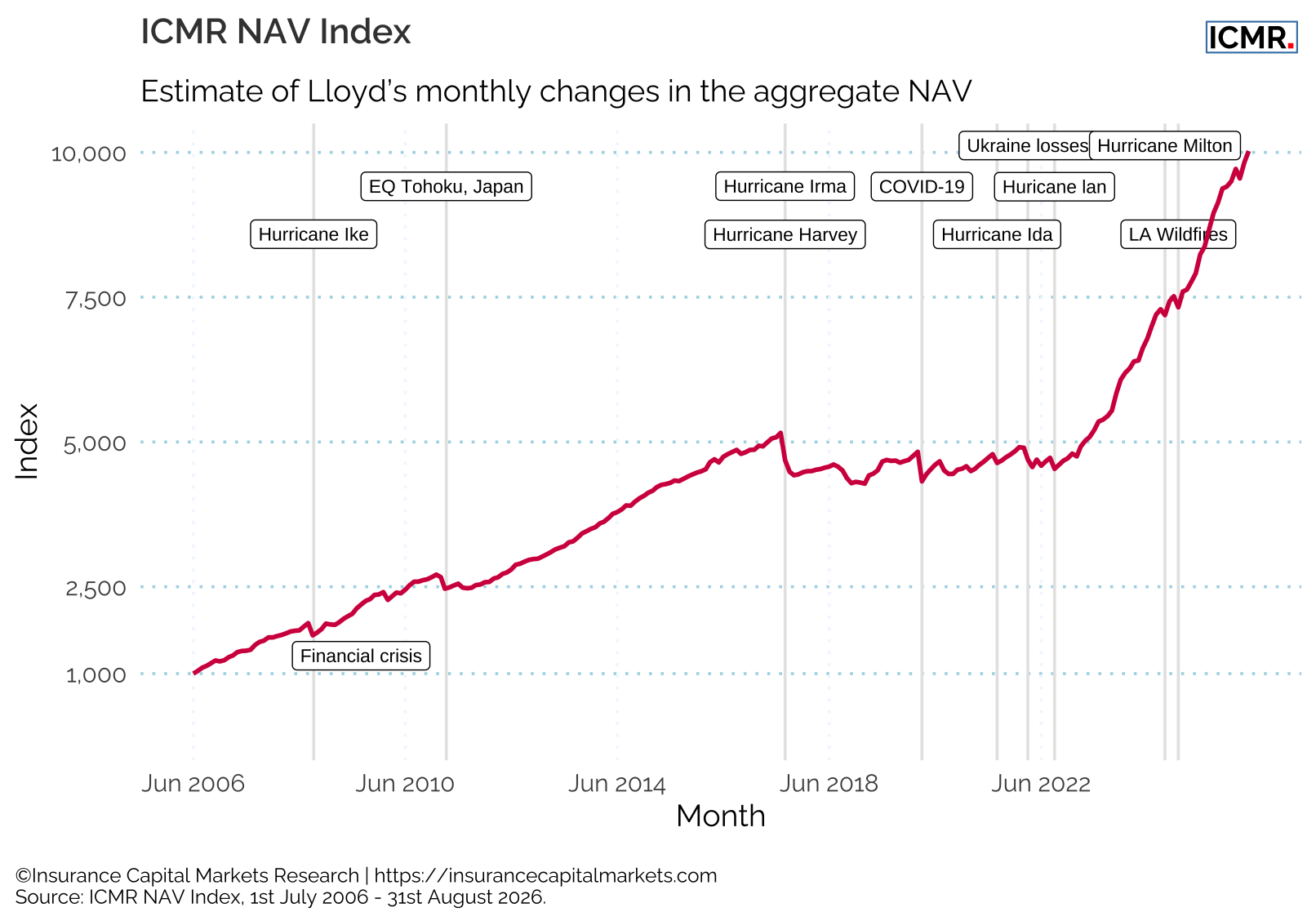
To bridge this gap, ICMR introduced the ICMR NAV Index; combining published financial Lloyd’s data, stochastic forecasting and regular true-ups to help develop a functional secondary market for direct specialty risk.
Driving Confidence: Learning Lessons from Adjacent Markets
Building market confidence requires total transparency. Previous attempts to create Lloyd’s indices stumbled by focusing on theoretical averages rather than underlying asset cash flows.
Here, the private credit sector offers a crucial cautionary lesson. Private debt currently faces PR headwinds over “mark-to-model” valuation opacity, delayed write-downs and hidden loan restructurings.
If Lloyd’s is to succeed, secondary trading cannot rely on subjective internal pricing. Catastrophe (Cat) bonds trade successfully because they exist as standardized 144A securitisations with strictly defined trigger mechanisms and established valuation conventions, even when backed by indemnity covers.
In contrast, unindexed syndicate cash flows carry multi-year liability tails, capital call commitments and severe data asymmetry. Market makers will only step in once objective, transparent Net Asset Values (NAVs) strip away that valuation uncertainty across any syndicate portfolio.
Institutional Liquidity & Valuation Transparency Matrix
| Asset Class | Structuring & Wrapper | Valuation Mechanism | Secondary Mobility | Transparency / Valuation Risk |
|---|---|---|---|---|
| Public Equities | Listed shares | Daily open-market exchange pricing | Immediate / Daily | High transparency; continuous trading. |
| 144A Cat Bonds / ILS | Standardised securitisations; defined triggers | Periodic mark-to-market broker pricing | Active secondary market | High transparency; clear loss-development rules. |
| Private Credit | Semi-liquid funds, feeder vehicles & LPs | Manager internal valuations (Mark-to-Model) | Growing GP/LP secondary market | Moderate/Low transparency; risk of “extend & pretend.” |
| Legacy Lloyd’s Participation | Finite 3-year accounts & annual capacity | Infrequent annual reporting with multi-year lags | Rigid / Illiquid | Low mobility; locked-up capital. |
| Syndicate Portfolios (ICMR Vision) | Continuous portfolio NAV wrappers | Objective modelled NAVs + regular true-ups | Targeted secondary market | High transparency; true-ups remove mark-to-model bias. |
The Path Forward: Building an Investment Continuum
At ICMR, we see this investor confidence in NAV for syndicates and portfolios as crucial in moving towards improved liquidity. That is why we developed our portfolio NAV service to fund investors at Lloyd’s and it is why we have developed our Lloyd’s NAV index.
Investment in Lloyd’s specialty (re)insurance risk shouldn’t remain a finite enterprise that must be commenced from scratch and then be wound up each time, despite the fact that that is how the underlying actually behaves. It must evolve into a continuum for investors in exactly the same way Cat bond funds, or indeed equities, are a continuum.
Contact ICMR today to discover how our quantitative insights can support your investment strategy at Lloyd’s.