W(h)ither the softening market?
As the news of rate softening continues, capital markets show no let up in their appetite for lower correlating returns.
If only the softening market would wither. Unfortunately rate reductions show no signs of abating. The diversity of market observers’ comments range from “nothing to see here” through to “some classes are already underwater”. The truth obviously lies somewhere between these, but where?
Market Sentiment vs. Underwriting Reality
As previously observed, when the Lloyd’s market begins to soften, the macro narrative usually suggests a uniform shift - the falling tide lowers all boats. However, as we discussed in our recent article the reality is quite different. And from looking at the continued appetite from investors, clearly they still see considerable upside potential even now.
This is evident anecdotally from the number of new syndicate start ups, not only over the last 12 months but also planning for a 1.1.2027 launch. We are aware of 8 new syndicates that have been announced to start next year. While these new launches demonstrate sustained capital appetite, they could potentially also add underwriting capacity into classes already facing downward rate pressure, widening the gap between top-quartile cycle managers and those chasing volume.
A Quantitative View via Capital Markets
Quantitatively, it is difficult to judge impacts of rate softening on overall returns, partly because rate change information is itself anecdotal and will vary client by client, even ostensibly for the same risk profile. An alternative quantitative approach is to look at the issue from the other end of the kaleidoscope, and that is to look to the Law of Large Numbers, which in this case can be represented by the collected views of the capital markets.
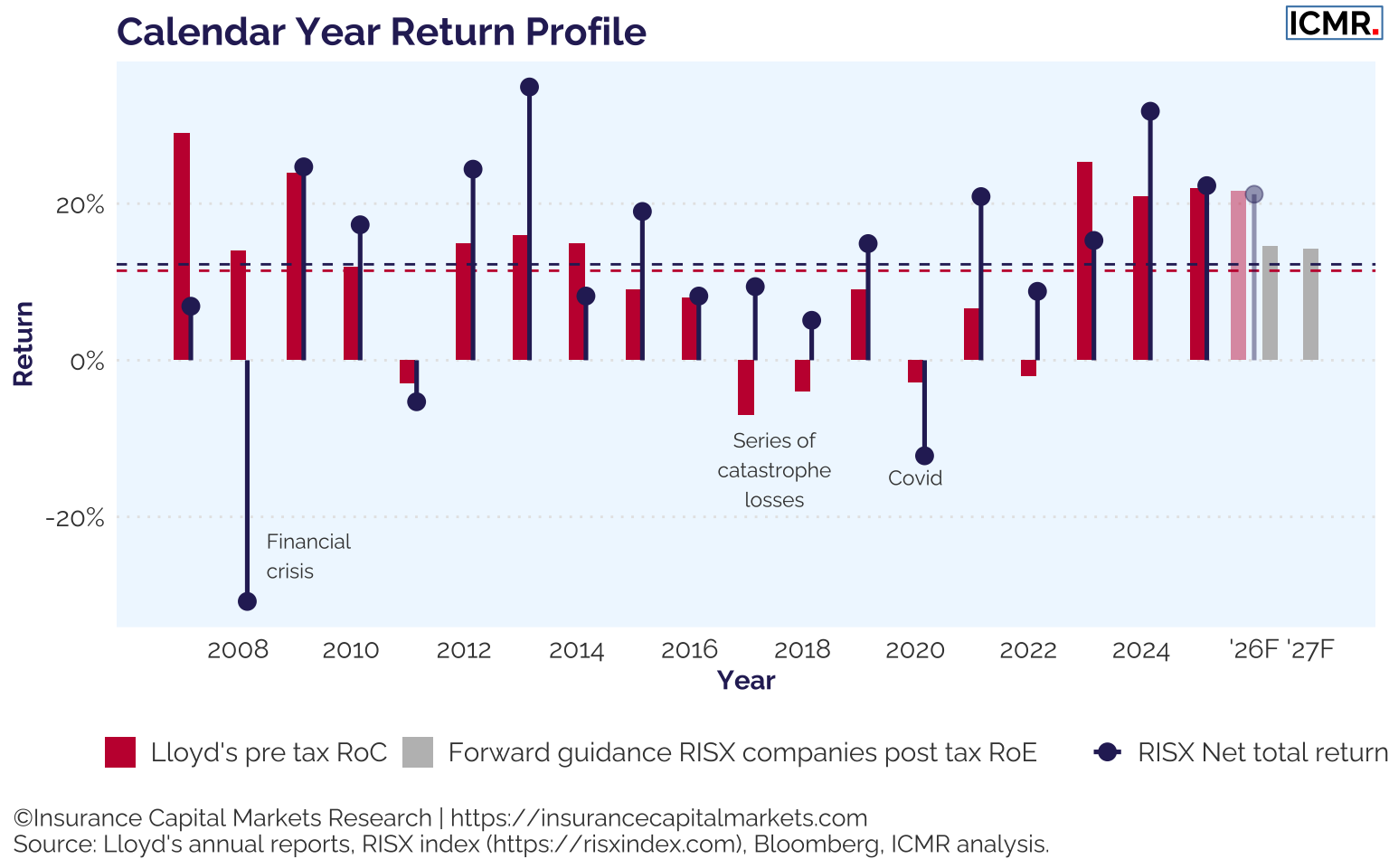
Using the RISX index as our reference - ICMR’s equity index comprising all the listed companies which own and control Lloyd’s managing agencies, and weighted by premium, not market capitalisation - we can look at what investors’ real time aggregate decision making is pointing toward. This can then be compared against what each of these companies’ various sell-side equities analysts are forecasting as forward guidance in respect of returns on equity.
The RISX Index as a Lead Indicator
ICMR’s RISX index has already become an accurate lead indicator of Lloyd’s own reported calendar year combined ratio, predicting the likely outcome a full month before Lloyd’s publishes its financial statements. The rolling RISX index performance has also been a good lead indicator of likely performance for Lloyd’s. Over the long term the performance of both Lloyd’s and the RISX index have been almost identical, which is unsurprising as they are both based on similar underlying syndicated business.
What this chart shows is that, despite forward guidance seeking to temper expectations, capital market investors’ interest and appetite remains very strong, as equity share price appreciation is well ahead of expected returns on equity. It should be noted that, comparing an equity market return directly to accounting ROE conflates two different metrics. Capital markets outperforming analyst guidance does not necessarily mean analysts got their combined ratio projections wrong; rather, it suggests investors are willing to pay higher price-to-book multiples for balance-sheet resilience and asset leverage against broader macro uncertainty.
This suggests that either capital market equity investors believe talk of rate softening to the extent of results soon being underwater is overplayed and there is still significant profit potential available for the next few years at least. Alternatively, they may be pricing in some degree of rate softening, but against the backdrop of wider economic uncertainty, they may feel the value creation potential of our sector will be preserved or enhanced in terms of book multiples.
Or they could just be wrong.
Outlook and Strategic Benchmarking
However, approximately half of returns on equity over the last three years of large profits have been from investments, and interest rates are more likely to drift up than drift down in the near term. Even with a soft market decline in underwriting returns, the prospects for the sector appear stable compared to other, more fashionable sectors.
Clearly, the range of individual syndicate’s performance will be as wide as it always is, as indeed will be the range of performance across RISX index companies. With planning for 2027 underwriting reaching its conclusions, this provides a timely further data point on views on cyclicality. Because headline market aggregates will inevitably mask the extreme divergence between underwriting performance and investment leverage, granular syndicate-level benchmarking is essential for capital allocation in 2027. ICMR’s publication, Syndicate Statistics, remains available for purchase via our website.